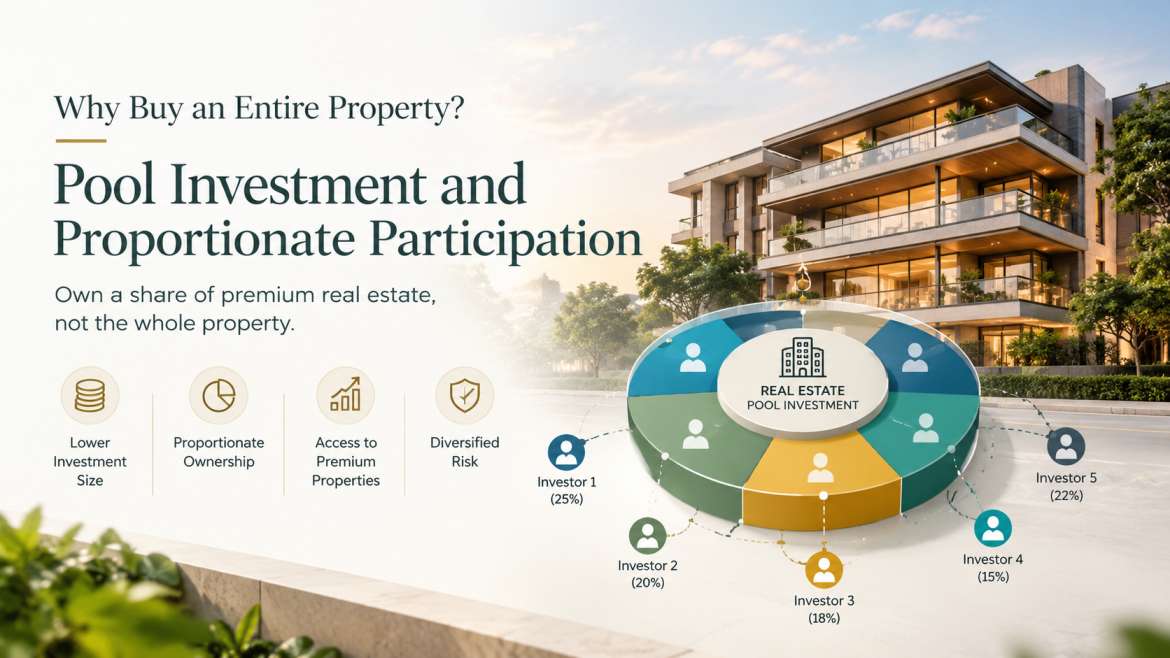
For many people, investment in real estate begins with a simple question: can I afford to buy a property? Real estate has traditionally meant owning a house, an apartment or a plot of land, and the capital required to acquire an entire property can be substantial, particularly in established markets such as South Delhi.
For individuals who want exposure to real estate but do not wish to commit the amount needed to purchase a whole property, this is a significant barrier. Even when an investor recognises the potential of a market, the size of the cheque may limit their ability to participate.
But what if you did not always have to fund an entire property to invest in real estate?
Across financial markets, shared participation has changed how people think about ownership. Investors can hold a stake in a business without buying the whole company, and they can invest through structures where many participants contribute capital towards a common objective. A similar principle can be applied to property through a professionally structured real estate fund, which brings together capital from multiple investors so each can participate in proportion to their contribution, subject to the structure and its terms.
In this guide, we explain how pool investment works, what proportionate participation means, how an AIF in real estate fits into the picture, and what you should check before you commit capital.
1. Understanding Pool Investment: When Multiple Investors Participate Together
Imagine a real estate opportunity that needs substantial capital. Traditionally, a single investor would have to arrange the entire amount to acquire the property or run the investment independently.
A pooled approach introduces a different possibility. Instead of relying on one individual to provide all the capital, multiple investors contribute towards a common investment vehicle. The capital is then deployed according to the vehicle’s defined investment strategy, and each investor participates in line with the amount invested and the rights attached to their investment.
For example, suppose a vehicle needs ₹10 crore in capital. Rather than one investor funding the full amount, several investors could provide it together: one might contribute ₹2 crore, another ₹1.5 crore, another ₹1 crore, and others the balance. Their respective participation would be determined by their contributions and the applicable investment terms.
The underlying principle is straightforward: multiple investors can combine capital to access an opportunity that might otherwise demand a much larger individual commitment. This is commonly described as pool investment, and in a real estate fund the pooled capital is managed under the fund’s investment mandate, governing documents and applicable regulations.
It is important to distinguish this from an informal arrangement where a few friends or relatives jointly buy a property. In a professionally structured fund, investors generally hold units or another legally defined investment interest. Their rights in relation to the underlying assets depend on the legal structure and documentation, not on informal understanding.
2. What Is Proportionate Participation?
One of the most important ideas in pooled investment is proportionate participation. In simple terms, it means an investor’s interest is determined according to their contribution and the applicable investment terms.
Consider a hypothetical vehicle with total subscribed capital of ₹10 crore. One investor contributes ₹2 crore, representing 20% of that capital. Another contributes ₹1 crore, representing 10%. The first investor has contributed twice as much as the second, and if the fund’s governing documents allocate participation on this basis, their respective economic interests would reflect that relationship.
However, precise rights and economic entitlements depend on the fund’s legal structure, unit allocation, fees, expenses and distribution provisions. A percentage of contributed capital should not automatically be read as direct ownership of the same percentage of a particular property’s title, or as a guaranteed share of its future value.
The concept becomes clearer when we separate two ideas:
- Owning an entire physical asset, which involves legal rights in the property itself.
- Participating economically in an investment associated with that asset, which involves rights defined by the fund’s structure and documents.
Both relate to real estate, but they are not necessarily the same form of ownership.
3. Learning from the Way Financial Markets Enable Participation
Participating in an asset without buying all of it is already familiar in financial markets. When investors buy shares of a company, they do not need to purchase the entire business. They acquire shares representing a defined interest, subject to the rights attached to those shares. Many other investment products similarly allow participation through smaller units rather than requiring ownership of the whole underlying asset.
Real estate presents a different set of considerations because it involves physical assets, property laws, transaction costs and often limited liquidity. Even so, pooled structures apply a related principle: investors contribute capital collectively, while their rights and economic interests are set by the investment vehicle.
The comparison is useful for understanding the concept, but it does not mean fund units are identical to listed shares, or that investors can trade or redeem them under the same conditions. The broader lesson is simply that investment in real estate does not always require one individual to acquire the entire underlying asset.
4. Why Does This Matter in South Delhi Real Estate?
South Delhi is an established residential market with neighbourhoods such as Greater Kailash, Defence Colony, Gulmohar Park, Neeti Bagh, Anand Niketan and Hauz Khas. These areas have developed over time and are associated with established communities, connectivity and access to social infrastructure. Limited land availability in mature neighbourhoods also means redevelopment and reconstruction can form an important part of the local property landscape.
However, participating directly in such a market can require significant capital. Acquiring a property involves more than its purchase price. Depending on the transaction, investors may need to account for stamp duty, registration charges, legal due diligence, financing costs, taxes, maintenance and other expenses.
Beyond money, direct ownership calls for an understanding of local market conditions, title documentation, approvals, redevelopment feasibility and potential exit options.
For investors who do not want to handle all of this independently, a professionally structured real estate fund can offer a different route. A South Delhi-focused fund concentrates its strategy on opportunities within a defined geographical market. Rather than requiring each investor to acquire and manage a complete property, the fund pools capital and deploys it according to its mandate. This is a structured way to invest in real estate through a particular strategy, subject to the fund’s minimum investment, eligibility criteria and governing documents.
5. How Does Pooled Real Estate Investment Work?
Although details differ between funds, the general process can be understood in five steps.
- The fund is established. It has a defined investment strategy, legal structure and governing documents that set out objectives, investment approach, investor eligibility, fees, risks and other terms.
- Eligible investors contribute capital. Contributions are made through the fund’s subscription process and pooled within the investment structure.
- Opportunities are evaluated. The investment team reviews property characteristics, market conditions, legal documentation, financial feasibility and other relevant factors in line with the mandate.
- Capital is deployed. The fund invests according to its strategy. Performance depends on market conditions, execution, costs and the eventual realisation of value.
- Proceeds are distributed or realised. When investments generate distributable proceeds or are realised, treatment is governed by the fund’s documents. The timing and amount of any distributions are not guaranteed.
This shows how pooled investment connects individual contributions to a collective strategy. It also highlights why investors should understand the fund’s actual operating model rather than assuming that every real estate fund works the same way.
6. What Is an AIF in Real Estate?
In India, many pooled real estate funds are set up as Alternative Investment Funds (AIFs) regulated by SEBI under the SEBI (Alternative Investment Funds) Regulations, 2012. An AIF in real estate is a privately pooled investment vehicle that collects money from investors and invests it in real estate-related opportunities under a defined strategy.
AIFs are divided into categories. Real estate funds commonly fall under Category II AIFs, which generally invest in unlisted companies, real estate and similar assets and do not typically use leverage beyond meeting day-to-day operational needs, subject to the regulations.
Some features of an AIF in real estate that investors should be aware of:
- Regulated structure: The fund is registered with SEBI and must operate within the AIF Regulations and its own placement memorandum.
- Minimum commitment: AIFs generally have a minimum investment threshold, which is typically ₹1 crore for most investors. This is why an AIF is usually aimed at investors with a higher capital capacity.
- Defined investment mandate: The fund states its strategy, geography, tenure and risks in its documents.
- Defined term: AIFs usually have a fixed tenure, and exits may be limited before the term ends.
- Disclosure and reporting: Investors receive periodic information as required by the regulations and the fund’s terms.
These points are general in nature. Thresholds, rules and categories can change, so always refer to the latest SEBI regulations and the fund’s offering documents.
7. Pool Investment vs. Direct Property Ownership
| Factor | Direct property purchase | Pool investment through a real estate fund |
|---|---|---|
| Capital needed | Full purchase price plus transaction costs | Contribution as per the fund’s minimum and terms |
| Nature of interest | Legal title to the property | Units or interest as defined in fund documents |
| Management | Handled by the owner | Handled by the fund manager under the mandate |
| Diversification | Usually one property | Depends on the fund’s strategy |
| Liquidity | Depends on finding a buyer | Depends on fund tenure and terms |
| Documentation | Title, registration, approvals | Fund documents, subscription agreement, PPM |
Neither route is automatically better. The right choice depends on your capital, goals, time horizon and comfort with the risks involved.
8. What to Check Before You Invest in Real Estate Through a Fund
Before you invest in real estate through any pooled structure, take time to review the following:
- Registration and structure: Confirm the fund’s SEBI registration, its category and its legal form.
- Investment mandate: Understand what the fund will invest in, where, and how.
- Fees and expenses: Check management fees, performance fees, setup costs and other charges, and how they affect returns.
- Tenure and exit terms: Know how long your capital will be committed and what exit options exist.
- Risk factors: Read about market, execution, regulatory, liquidity and concentration risks.
- Track record and team: Look at the sponsor’s and manager’s experience in the relevant market.
- Tax treatment: Consult a tax professional about how fund income and gains may be taxed in your case.
A well-informed decision starts with reading the placement memorandum and asking questions until you are comfortable.
Conclusion
Owning an entire property is one way to take part in real estate, but it is not the only way. Pool investment allows multiple investors to contribute to a shared strategy, with proportionate participation determining each investor’s interest according to the fund’s terms. For those looking at investment in real estate in a market such as South Delhi, a professionally structured real estate fund or an AIF in real estate can offer a structured route to participate without independently buying and managing a whole property.
At the same time, pooled investment is not risk-free or guaranteed. Returns depend on market conditions, execution and the fund’s terms, and units are not the same as direct title to a property. Review the documents carefully, understand the fees, risks and exit conditions, and seek independent financial, legal and tax advice before you invest.
Frequently Asked Questions (FAQs)
1. Do I need to buy an entire property to invest in real estate?
No. While buying a house, apartment or plot is the traditional route, you can also invest in real estate through pooled structures such as a real estate fund, where multiple investors contribute capital towards a shared strategy and participate according to their contribution and the fund’s terms.
2. What is pool investment in real estate?
Pool investment is an arrangement where several investors combine their capital in a single investment vehicle. The vehicle invests according to a defined mandate, and each investor’s participation is based on the amount contributed and the rights attached to their units or interest.
3. What does proportionate participation mean?
Proportionate participation means an investor’s interest in the pool is linked to the share of capital they contribute, subject to the fund’s governing documents. For instance, an investor who contributes ₹2 crore to a ₹10 crore fund holds a 20% share of contributed capital, though actual returns also depend on fees, expenses and distribution terms.
4. Does proportionate participation mean I own that percentage of the property?
Not necessarily. In a fund, you typically hold units or an interest defined by the fund documents, not direct legal title to a specific property. Your rights depend on the legal structure and documentation of the fund.
5. What is a real estate fund?
A real estate fund is an investment vehicle that pools money from investors and deploys it into real estate-related opportunities under a stated strategy. It is managed by a professional team and governed by its offering documents and applicable regulations.
6. What is an AIF in real estate?
An AIF in real estate is an Alternative Investment Fund registered with SEBI that invests in real estate-related assets. Such funds are commonly structured as Category II AIFs and operate under SEBI’s AIF Regulations and the fund’s own placement memorandum. Call : +91-8851584221
7. What is the minimum investment in an AIF?
AIFs generally require a minimum commitment, which is typically ₹1 crore for most investors, with limited exceptions under the regulations. Always confirm the current threshold and the fund’s own requirements before investing.
8. How is investing in a real estate fund different from buying a property directly?
With direct purchase, you hold title, bear the full cost and handle management and exit yourself. With a real estate fund, you participate through units, the fund manager handles execution, and your returns and exit depend on the fund’s strategy, tenure and terms.
9. Are returns from pooled real estate investment guaranteed?
No. Returns depend on market conditions, project execution, costs, fees and the eventual realisation of value. The timing and amount of distributions, if any, are not guaranteed.
10. Can I exit a real estate fund whenever I want?
Not usually. AIFs typically have a fixed tenure, and early exit options may be limited or subject to conditions. Check the fund’s liquidity and redemption terms before investing.
11. Who can invest in an AIF in real estate?
Eligibility depends on SEBI’s regulations and the fund’s terms. Investors generally need to meet the minimum commitment and complete the fund’s onboarding and KYC process, and some funds may restrict participation to specific investor types.
12. What should I check before I invest in real estate through a fund?
Review the fund’s SEBI registration, investment mandate, fee structure, tenure, exit terms, risk factors, sponsor track record and tax implications. Reading the placement memorandum and speaking to an independent advisor can help you decide.